
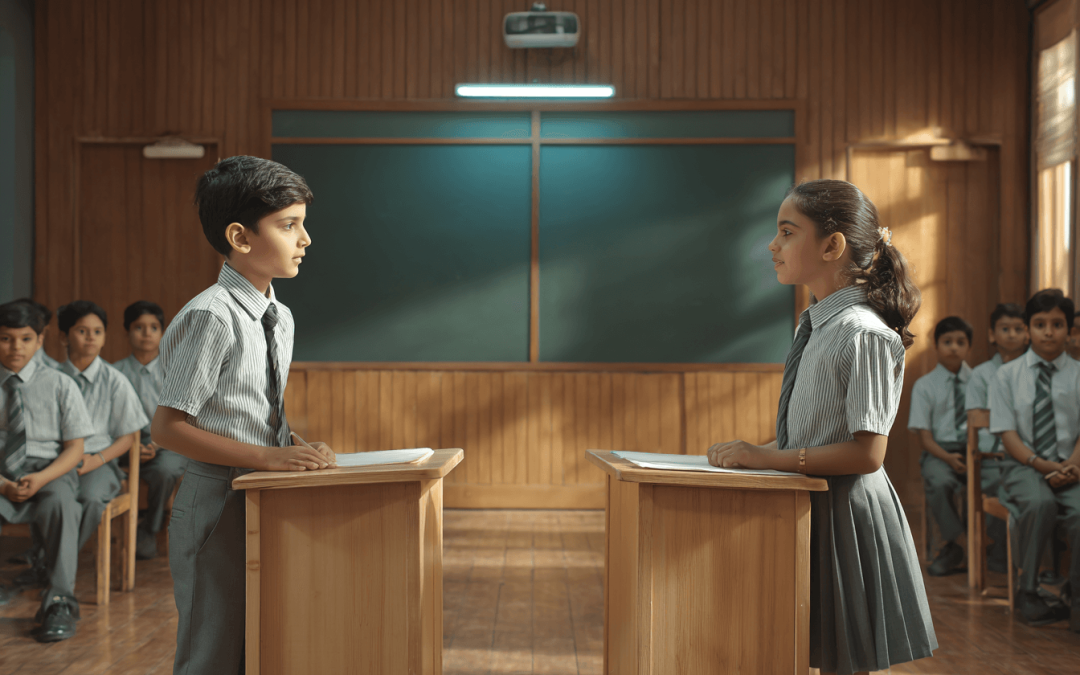
The Union Public Service Commission (UPSC) Civil Services Examination is one of India’s toughest journeys. Most people think of it as a marathon of reading, writing, and rote memorisation. But the last hurdle, the Personality Test (Interview) is different. It’s not about what you know, but how you think, how you speak, and who you are as a person.
At Nalanda School, one of the top schools in Hyderabad, we believe that true readiness for this stage can’t be achieved in a two-month coaching course. It begins much earlier, woven into the very fabric of daily school life through our powerful debate culture school. This foundational approach is how we naturally build the interview skills school students need, turning everyday learners into future civil servants.
How Early Debate Habits Shape Future Civil Servants
The UPSC interview panel isn’t looking for a walking textbook. They seek officers with critical thinking for UPSC, individuals who can analyze a complex problem, weigh pros and cons, and articulate a balanced judgment. Where does this start? Not in a study hall, but in an engaging classroom debate.
When a student argues for or against a public policy, they are practicing logical reasoning habits. They learn to quickly assimilate information, structure their thoughts logically, and defend their perspective without becoming aggressive or emotional. This isn’t just a competitive sport; it’s a profound form of personality development school offers, shaping a balanced and mature outlook essential for the highest levels of public service.
Why Nalanda Introduces UPSC-Oriented Thinking from Class 6
Most schools wait until Class 12 or college to talk about civil services. At Nalanda, UPSC preparation at Nalanda starts from Grade 6.
Before you worry about your child being stressed or overloaded, let us assure you: Students are not stressed or overloaded. Our approach is about understanding, not ‘ratification’ or mugging. We introduce the idea of civil service, the concepts of governance, ethics, and social issues not as separate syllabus points, but as topics for exciting, real-world structured expression.
This school-level UPSC foundation focuses on the ‘why’ and ‘how’ of current affairs. Instead of memorising a government scheme, students discuss its potential impact on different sections of society. This gentle, curiosity-driven exploration naturally builds a deep and genuine awareness, which the UPSC interview panel values far more than surface-level facts.
How Discussions Build Confidence for the UPSC Personality Test
The UPSC personality test preparation is fundamentally a test of your mental poise and communication. Many brilliant aspirants falter because they lack communication confidence under pressure.
Our debate culture school is the antidote to this anxiety. By regularly participating in formal and informal discussions:
- Students shed fear: Public speaking becomes a daily habit, removing the panic of facing a formidable panel.
- Students gain clarity: Expressing complex ideas to peers forces them to be clear and concise, a trait the UPSC board absolutely requires.
- Students learn humility: In the true spirit of ancient Nalanda, our debates teach students to appreciate a superior counter-argument, fostering the open-mindedness and intellectual integrity critical for a civil servant.
The Science Behind Voice Modulation, Demeanor & Analytical Expression
The interview is a conversation, but a highly analytical one. Success hinges on the subtle art of presentation.
Nalanda’s focus on debate helps students master analytical expression by making them aware of their voice and body language. They learn to use voice modulation to convey conviction, maintain eye contact to project sincerity, and use measured language to show balance of judgment. These are non-verbal cues that tell the panel: This is a composed, thoughtful, and capable leader. This is an integral part of our holistic education methods.
How Nalanda’s No-Stress, Understanding-First Culture Builds True Interview Readiness
The goal of Nalanda is not to create children who aspire to clear UPSC, but children who are inherently ready for the responsibilities of a civil servant. This is the difference between learning to pass an exam and preparing for a lifetime of service.
Our child-friendly UPSC training ensures that learning is an organic process. By focusing on deep, conceptual understanding over surface-level cramming, our students develop answers that are original, insightful, and deeply human, answers that reflect a true grasp of social realities, not just bookish knowledge. This authentic engagement is impossible to fake in the interview room.
Real Classroom Scenarios That Shape UPSC-Ready Minds
- The Budget Exercise: Students in class don’t just study the Union Budget; they hold a mock cabinet meeting to debate the allocation of funds for education vs. healthcare, forcing them to understand trade-offs and priorities, a quintessential UPSC scenario.
- Ethical Dilemma Discussions: A class discussion on a hypothetical scenario (e.g., “A factory providing jobs is polluting a nearby river. What do you do?”) forces students to apply ethical frameworks and demonstrate intellectual and moral integrity in real-time.
FAQs
1. Is starting UPSC preparation from Class 6 too early?
A. No, because our focus is not on Mains syllabus but on developing the mental aptitude and critical powers of assimilation required for the Personality Test. We build the foundation of critical thinking for UPSC and awareness of public life in an age-appropriate, fun, and conversational manner, ensuring zero academic pressure.
2. How does debate help with the written Mains exam?
A. While the interview is the direct beneficiary, our debate culture school drastically improves your answer-writing by fostering a clear and logical exposition. Debaters naturally structure arguments well, use evidence efficiently, and write concisely, leading to high-scoring, well-reasoned answers in the Mains papers.
3. Will my child become overly argumentative or defensive from debating?
A. Absolutely not. The Nalanda Debate tradition, like that of the ancient university, stresses the importance of humility and respectful disagreement. The goal is to reach a balance of judgment by exposing logical inconsistencies, not winning by shouting. We teach them to be assertive in their views but humble in their approach, a key quality for any effective administrator.
4. Does Nalanda encourage students to maintain a ‘neutral’ view on every topic for UPSC?
A. We encourage students to form an informed and well-reasoned opinion, but also to acknowledge the legitimacy of alternative views. The UPSC panel respects a candidate who can articulate a clear stance while demonstrating empathy and perspective-taking by understanding why a different policy or view might exist. Our training builds this nuanced, mature intellectual profile.
Conclusion
The UPSC personality test preparation is the ultimate validation of a truly holistic education methods. At Nalanda, we don’t just prepare students for an exam; we prepare them for the challenge of serving a nation. We instill the communication confidence and the critical thinking for UPSC that makes a true leader.
If you are a student or a parent who values this kind of deep, lifelong preparation over last-minute coaching, we invite you to explore the Nalanda difference. Discover how a strong debate culture school is the best first step toward achieving the dream of Civil Services.
Begin your child’s foundational journey today. Explore admissions and learn more about our unique curriculum at Nalanda School.
Follow us on Instagram
Recent Comments